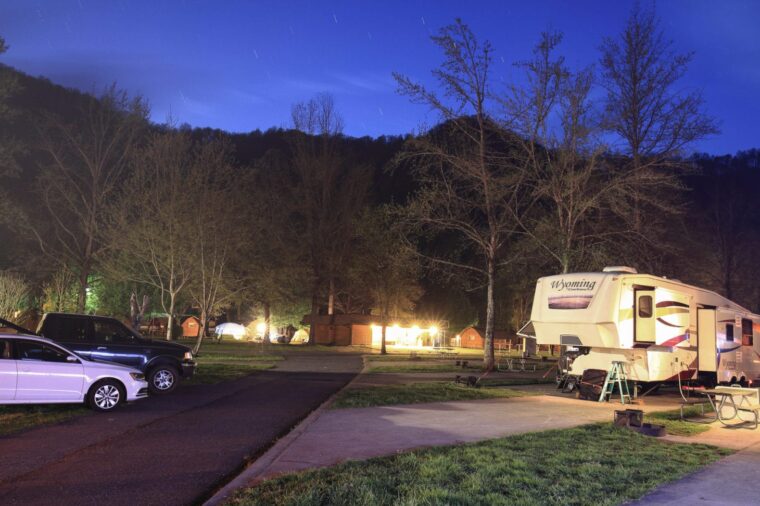
Dry camping means staying in an RV without water, electrical, or sewer hookups. You rely on your RV’s fresh water supply, batteries or other power sources, propane when needed, and holding tanks for wastewater.
It can happen at a campground with no-hookup sites, on public land where camping is allowed, or at certain private-property and overnight parking locations. With this guide, you’ll learn how dry camping differs from boondocking and dispersed camping, how to prepare your RV, manage water, power, and waste, and find places that work for your rig and trip.
TL;DR
- Dry camping means RV camping without water, electrical, or sewer hookups. You rely on your RV’s onboard water, batteries or other power sources, propane, and holding tanks.
- Boondocking is one type of dry camping, but dry camping can also happen in campgrounds, parking areas, or on private property where overnight stays are allowed.
- Your practical limit is usually water, power, waste capacity, or local stay rules. Plan those before arriving and use campground reviews and location information to confirm whether a site works for your RV.
What Is Dry Camping?
Dry camping is RV camping without connections to fresh water, electricity, or sewer at your campsite. Instead, you depend on the water stored in your RV, onboard batteries or another power source, and your gray and black holding tanks until you can refill, recharge, or dump them.
“No hookups” means your RV is not connected to campground utilities during your stay. You need to plan around the capacity of the systems you bring with you.
| Utility | At a hookup site | While dry camping |
|---|---|---|
| Fresh water | Connected to campground water | Fresh water tank or stored water |
| Electricity | Shore power | RV batteries, solar, generator, or another charging source |
| Sewer | Sewer connection | Gray and black holding tanks |
A dry camping site may still have other campground facilities, such as restrooms, trash service, or potable water nearby. The defining feature is that your campsite does not provide the water, electrical, and sewer hookups your RV would normally connect to.
Dry Camping vs. Boondocking vs. Dispersed Camping
These terms overlap, but they describe different parts of the camping experience. Dry camping describes your hookup situation, while boondocking and dispersed camping are more specific about where or how you camp. Primitive camping generally refers to the level of development and amenities at a site.
| Term | What it means | Typical setting |
|---|---|---|
| Dry camping | RV camping without water, electrical, or sewer hookups | Campgrounds, public land, private property, or permitted overnight parking |
| Boondocking | Dry camping outside a developed campground, usually with few or no services | Public land and other undeveloped camping areas |
| Dispersed camping | Camping outside a developed campground, most often on public land where it is allowed | National forests, BLM land, and other permitted public lands |
| Primitive camping | Camping at a site with few or no developed amenities | Developed primitive campgrounds or undeveloped areas |
The terms are sometimes used interchangeably, so context matters. An RVer camping on dispersed public land is usually dry camping, but someone staying at a no-hookup site inside a developed campground is also dry camping without necessarily boondocking or dispersed camping.
Learn more about boondocking basics and dispersed camping before planning a stay outside developed campgrounds.
Can you dry camp at a regular campground?
Yes. Many developed campgrounds have designated campsites without individual water, electrical, or sewer hookups. You may still have access to shared facilities such as restrooms, potable water, or a dump station, but your RV remains disconnected from utilities at the campsite.
Why Do RVers Dry Camp?
Dry camping gives RVers more choices when full hookups are unavailable or unnecessary. It can make no-hookup public campgrounds accessible, provide a practical option for overnight travel stops, and sometimes reduce campsite costs. It is also a useful way to learn how your RV performs without hookups before trying more remote boondocking.
Common reasons RVers dry camp include:
- More places to stay: No-hookup campsites can expand your options beyond full-service RV parks.
- Potentially lower costs: Some dry camping sites cost less than sites with full hookups, though dry camping is not always free.
- Access to public campgrounds: Many national forest, national park, state park, and other public campgrounds offer sites without hookups.
- Overnight travel stops: Permitted overnight parking can give RV travelers a place to stop between longer driving days.
- Greater flexibility: Knowing how to camp without hookups makes it easier to use a wider range of campsites.
- Practice before boondocking: A developed campground without hookups can be a lower-pressure place to learn how quickly you use water, battery power, and tank capacity.
Dry camping also comes with limits. Fresh water must last until you can refill, batteries need a charging plan, and gray and black tanks have finite capacity. Running air conditioning, electric heat, and other high-draw appliances can also be difficult without shore power. Longer stays usually require more attention to water, power, waste, fuel, and nearby services.
Where Can You Dry Camp?
Dry camping can happen anywhere overnight RV use is allowed and hookups are not provided. That includes developed campgrounds, public land, private property, and some overnight parking locations.
- Campgrounds without hookups: National forest, national park, state park, municipal, and other campgrounds may offer designated sites without individual water, electrical, or sewer hookups. Some still provide shared facilities such as potable water or dump stations.
- Public land: Dry camping is possible on some BLM and National Forest lands where camping is permitted. Rules, access, and stay limits vary, so check the managing agency before your trip. For more detail, see Campendium’s guides to BLM camping.
- Private property: You can also dry camp on private property with the owner’s permission or through a host program that allows RV overnight stays.
- Overnight parking: Some businesses, casinos, rest areas, and other locations permit overnight RV parking. Permission can vary by property and local regulations, so confirm the rules before settling in for the night.
Dry camping describes the absence of hookups; it does not automatically mean you are allowed to camp or park somewhere.
How to Prepare Your RV for Dry Camping
Dry camping is easier when you know what each RV system can handle before you arrive. Start with full fresh water, charged batteries, empty waste tanks, and enough fuel or propane for the appliances you expect to use. Then keep an eye on each system during your stay.
| RV system | Before arriving | What to monitor |
|---|---|---|
| Fresh water | Fill tank | Daily water use |
| Gray tank | Empty tank | Sink and shower water |
| Black tank | Empty tank | Toilet use |
| Batteries | Fully charge | State of charge |
| Propane or fuel | Fill as needed | Heating, cooking, and appliance use |
Water
Know the capacity of your fresh water tank and arrive with enough water for your planned stay. Showers, dishes, cooking, drinking, and pets can use more than expected, so track how quickly the tank drops.
Conserve water where practical and carry additional potable water when your trip length, location, or RV setup calls for it. Also know where you can refill before heading into an area with limited services.
Waste tanks
Start with empty gray and black tanks. Your gray tank collects wastewater from sinks and showers, while the black tank generally holds toilet waste.
Reducing shower and sink water can help the gray tank last longer. Before your trip, identify a legal dump station along your route so you are not searching for one after a tank is already close to full.
Power
Your RV batteries supply electricity when you are not connected to shore power. How long they last depends on battery capacity and what you run.
Several methods can replace some of the power you use:
- Batteries: Store the electricity your RV uses while disconnected from shore power.
- Solar panels: Can recharge batteries when sunlight and your system allow.
- Generator: Can provide power or recharge batteries where generator use is permitted.
- Alternator or driving charge: Some RV setups recharge house batteries while the vehicle is running.
Solar panels and generators are not required for every dry camping trip. A short stay with modest electrical use may only require a charged battery bank.
Propane
Depending on your RV, propane may run appliances such as the furnace, water heater, refrigerator, or stove. Other rigs use electricity, fuel, or a combination of systems.
Check what your appliances actually use before leaving and monitor your propane or fuel supply accordingly. That becomes especially important when cold weather or frequent cooking increases consumption.
How to Find Dry Camping on Campendium
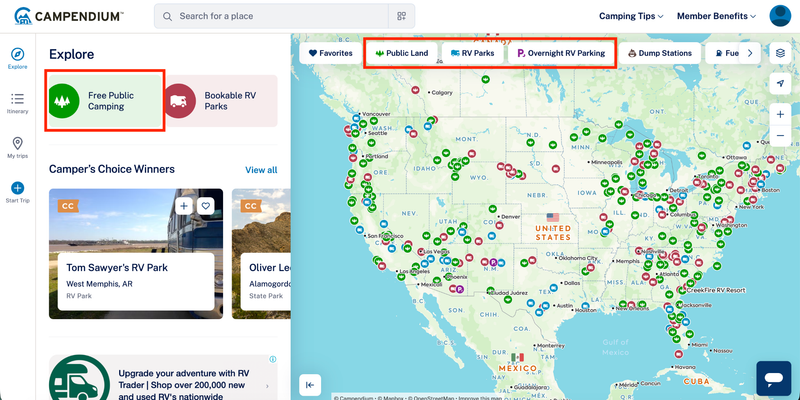
A simple way to plan a dry camping stay is to follow four steps: search, evaluate, verify, save backups. Campendium combines map-based discovery with camper reviews and RV-specific details that can help you narrow down locations before you arrive.
- Search the map. Browse the area you plan to visit and look beyond traditional RV parks and full-hookup campgrounds.
- Filter for relevant camping types. Check Free Camping, BLM, and National Forest options when those fit your trip.
- Evaluate each location. Read recent reviews, look through traveler photos, and check notes about road access, site conditions, and rig fit.
- Check reported cell service. Cell reports can help if you need connectivity during your stay.
- Plan for RV services. Look for nearby dump stations and other useful stops before heading into an area without hookups.
- Save backup locations. Keep a few alternatives in case access, rules, weather, or site availability changes.
Campendium also lets travelers save locations and use RV trip-planning tools to organize stops along a route.
Frequently Asked Questions
Dry camping means staying in an RV without water, electrical, or sewer hookups. You rely on your RV’s stored water, batteries or other power sources, and holding tanks during your stay.
No. Dry camping is the broader term for RV camping without hookups. Boondocking is a type of dry camping that usually takes place outside developed campgrounds, often in more remote areas.
Not necessarily. Some dry camping locations are free, but campgrounds can charge a nightly fee for sites without hookups. Dry camping refers to the lack of campsite utilities, not the price.
Yes. Many developed campgrounds offer campsites without individual water, electrical, or sewer hookups. Shared facilities such as restrooms, potable water, or a dump station may still be available.
There is no standard number of days. Your stay depends on factors such as fresh water, gray and black tank capacity, battery charge, propane or fuel, food, weather, and local stay limits. The first resource you run short on usually sets the practical limit.
Find Your Next Dry Camping Spot With Campendium
Dry camping comes down to managing your RV without campsite hookups. Knowing your water, battery, waste, and fuel limits makes it easier to choose a stay that fits your rig and decide when you need to refill, recharge, or dump.
Ready to try dry camping? Explore Campendium to compare no-hookup campgrounds and public-land camping options, then check camper reviews, photos, cell reports, access notes, and nearby dump stations before you choose a site. Save a few backup locations in case access, availability, or conditions change before you arrive.